
programmes

Modules through which we build digital, programming, robotics, networking, and multimedia skills.

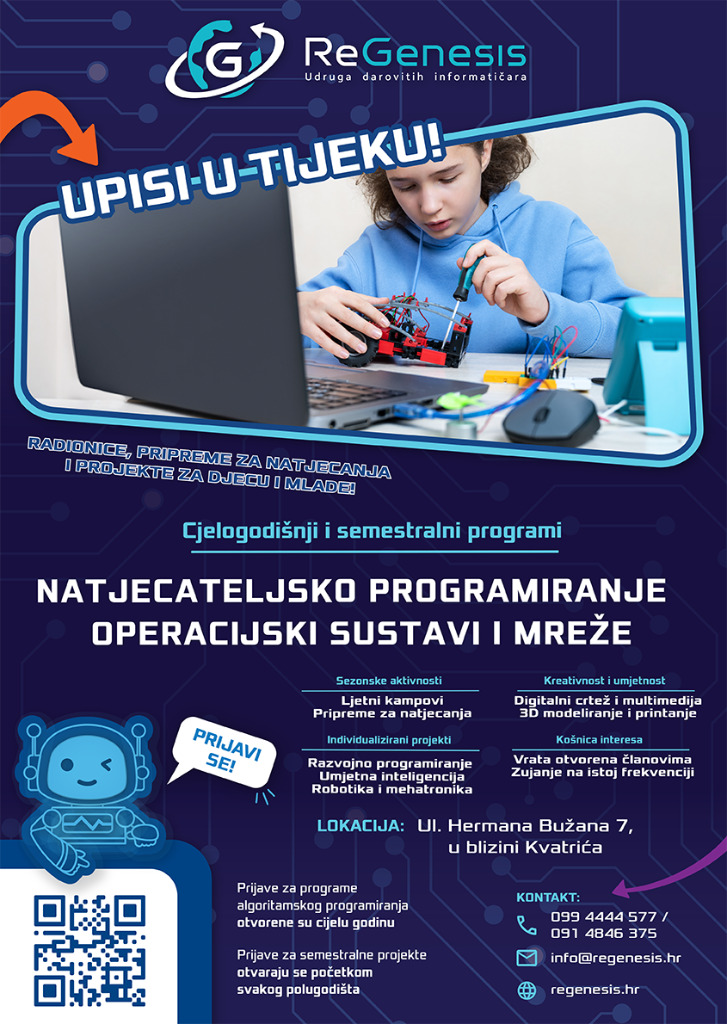
Flyer with enrolment details and programmes of the ReGenesis Association

The Association works in technical and computing culture, digital literacy, making, and the responsible use of technology. Learning is long-term, and participants progress by what they know, not by age. Some modules run for the whole school year, and some for one semester, depending on the group’s focus and interests.

modules

For younger and older primary-school pupils, and secondary-school pupils

Algorithmic programming

What you will learn

  • Write your first program and a small game you can show your friends
  • Teach the computer to repeat a boring job instead of you
  • Solve a task that would take days by hand, in one second
  • Explain why one solution is fast and another is too slow
  • Count how many ways something can happen and prove that it is correct
For younger and older primary-school pupils, and secondary-school pupils

Project programming

What you will learn

  • Make your own web page that anyone can open
  • Make a game in which a character jumps and collects points, and publish it
  • Save data so that they remain when you turn the computer off
  • Work on the same project with a friend without wiping each other's work
  • Find and fix a bug in your code instead of guessing

For younger and older primary-school pupils, and secondary-school pupils

Artificial intelligence

What you will learn

  • Use AI as a tool and catch it when it invents an answer
  • Make something of your own with the help of AI: text, an image or a small program
  • Recognise when a graph in a newspaper or on the internet is misleading
  • Make an honest graph from data you collected yourself
  • Recognise a scam, a fake prize and an application that keeps you on the screen

For younger and older primary-school pupils, and secondary-school pupils

Creative workshops and art

What you will learn

  • Edit a photograph and draw a picture on the computer
  • Record sound and clean it so that your voice sounds clear
  • Edit a short film: cuts, music and transitions
  • Add subtitles so that people who cannot hear can watch your video too
  • Know which music and images you may use in your work, and which you may not

For younger and older primary-school pupils, and secondary-school pupils

Operating systems

What you will learn

  • Organise files so that you never again have to look for where something ended up
  • Make a backup so that your photos do not disappear when the computer breaks down
  • Explain why a computer becomes slow over time and how to help it
  • Install a second operating system (Linux) in a safe virtual machine
  • Tell the computer what to do by typing in the terminal, without clicking the mouse

older primary-school pupils and secondary-school pupils

Networks

What you will learn

  • Draw a map of your home network and know everyone who is on it
  • Make a network cable yourself and connect two computers
  • Explain the path by which a photo from your phone reaches the other side of the world
  • Set strong passwords, two-factor authentication and a passkey on your accounts
  • Recognise a scam in a message and know what to do if you lose your phone

For younger and older primary-school pupils, and secondary-school pupils

Robotics and mechatronics

What you will learn

  • Build a robot that moves by itself
  • Add a sensor so that it stops before a wall
  • Control the motors and teach the robot to drive a given course
  • Make a badge (micro:bit) that lights up and shows a message
  • Make a device that even Grandma knows how to switch on and use straight away

Free activities

What matters most

What you will learn

  • Automate work in Minecraft with belts and redstone
  • Plan a large factory in Factorio and see what breaks when it grows
  • Draw a 3D model and print it so you can take it home
  • Program a drone to fly a set path on its own
  • Come to the playroom, play and carry on your projects with a mentor

Detailed curricula, with learning outcomes, levels of mastery, and topics, are on a separate page.

Curricula